Bilingual Construction Supervision
Your eyes, voice, and taste on the construction site — weekly visits, weekly reports in English, mistakes caught before they set.
- Next step
- Schedule a site visit
- Timeline
- Duration of the build
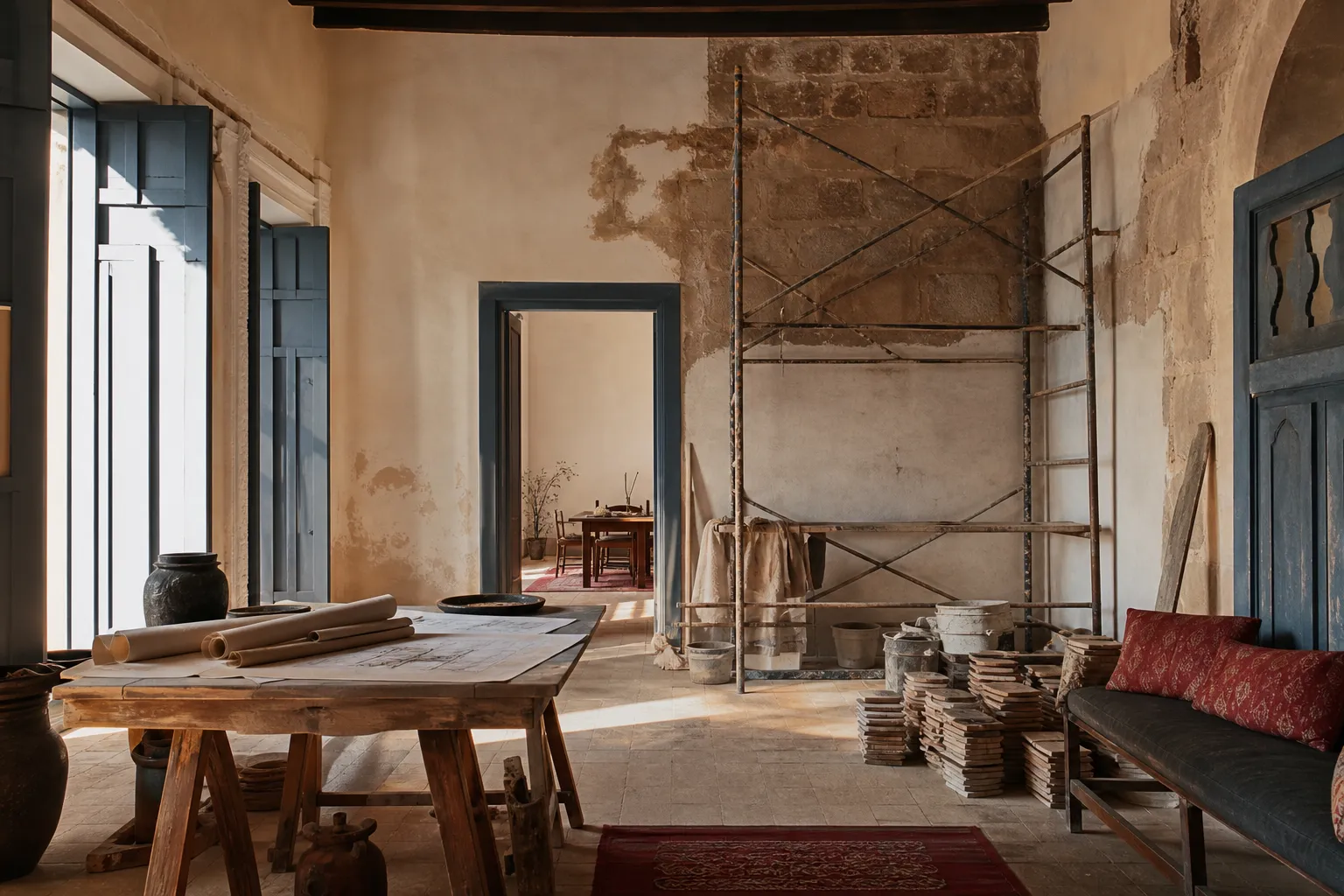
Every expat in San Miguel knows a renovation story. The finish that came out nothing like the photo. The wall that moved a meter left of the plan. The build that was “two weeks away” for seven months, discovered only on the owner’s next flight down. None of these stories involve bad people — they involve a 3,000-kilometer gap between the owner and the site, a language barrier in both directions, and nobody on the ground whose only job is the owner’s interest.
Construction Supervision is that job.
What does construction supervision involve?
Four things, every week, for the duration of your build.
Weekly site visits, documented. We walk the site against the plans: progress, finishes, details, and the early signals of trouble — the plumbing rough-in that forecloses your bathroom layout, the window casing about to be resolved by site habit rather than by the drawings. Catching these in the week they happen is the entire economics of the service; concrete is cheap to move on Tuesday and ruinous to move in a month.
The weekly report, in English. Photos, video, a plain-English summary of what happened, what is next, and what needs your decision. Owners abroad tell us this report is the difference between a renovation they are running and a renovation happening to them.
Decision translation. Every builder question reaches you framed clearly, with our recommendation attached: what is being asked, what each option implies, which one we would choose and why. You decide with full information, in your own language, in minutes instead of weeks.
Quality control against design intent. Not just “was it built” but “was it built to the standard the design assumed” — the finish quality, the alignments, the details that separate a house that photographs well from one that almost does.
At the end: a punch-list walkthrough with the builder, and a closeout report documenting what was delivered.
What construction supervision does not include
We are not your general contractor, and this is a promise rather than a limitation. You contract directly with your builder. We never contract construction under our own name — which means we carry no margin on the construction, protect no crew, and have no incentive to bury a problem we find. The moment an overseer profits from the build itself, their loyalty splits. Ours doesn’t.
It also keeps your legal position clean: your contract with the builder is direct, in your name, with no intermediary to complicate recourse if the relationship sours.
Who needs this?
Owners running a build from abroad. The obvious case. If you are in Denver and your walls are in San Miguel, the weekly report is your renovation. Without it, you are managing a construction project through a translation app and a builder’s WhatsApp photos, cropped by someone with every reason to crop generously.
Owners who are here, but out of their depth. Being on site does not mean knowing what you are looking at. Is that crack settling or structure? Is this tile layout what the drawing intended? Fluency in construction — and in construction Spanish — is a profession, not a personality trait.
Anyone whose renovation will end in a furnishing project. A build supervised against design intent hands over rooms that are ready — correct outlet positions, lighting where the plan needs it, finishes that flatter the furniture instead of fighting it. Supervised builds flow into Tier 2 furnishing without the expensive month of corrections that unsupervised builds usually require first.
How is the service scoped?
Two ways, depending on how you arrive.
Within a design package: when a turnkey project adds renovation work, construction supervision is scoped alongside it. The renovation itself stays out of turnkey scope — your contract with the builder is separate and direct — but the supervision integrates with the design work, which is exactly when supervision is most valuable.
Standalone: sized to the project, with the same weekly cadence, reports, and closeout — available whether or not we ever touch your furniture.
Either way, the value is practical. A single caught mistake — a mislaid floor, a mispoured stair, a bathroom plumbed to the wrong wall — can prevent months of rework. Most builds offer several such opportunities.
How does it start?
Onboarding. We review the plans, the contractor’s scope, and the finish selections, then hold an alignment call with the builder. This meeting does quiet, important work: the crew now knows a design-literate, Spanish-speaking professional walks the site every week. Standards rise before we ever flag a thing.
Then the rhythm. Weekly visit, weekly report, decisions translated as they arise, problems flagged while they are still cheap. It runs until the build does what builds almost never do unsupervised: end.
Closeout. The punch-list walkthrough, the final report — and, if the project continues into furnishing, empty rooms that are actually ready for what comes next.
If you are choosing a builder right now, or mid-build and feeling the distance, schedule a visit. Bring the plans. We will tell you honestly whether your project needs construction supervision or simply clearer communication with your builder.